
INTEGRATED ENGINEERING AND EQUIPMENT BUILD
Leading with Lean Solutions
Complex manufacturing challenges require more than standard equipment and conventional automation. We bring engineering disciplines together to solve difficult production problems holistically, resulting in operator safety, improved performance, and documented quality.
What is holding back your production?
01
Equipment Limitations
Your current machinery can't meet requirements, and your equipment builder has no feasible solution.
02
Capacity & Labor
Growing demand, labor shortages, or inefficient processes are limiting production.
03
Reliability & Quality
Downtime, inconsistent results, and recurring equipment problems are increasing costs.
04
Unsolved Engineering Challenges
Standard equipment doesn't exist, previous attempts failed, or the technical solution isn't clear.
Solve the Real Problem—not Just the Visible One
OUR APPROACH
Manufacturing problems rarely come with obvious answers. Your existing equipment may no longer meet production requirements. A machine builder may be unable or unwilling to make necessary changes. Increasing demand may expose bottlenecks, labor limitations, or process inefficiencies, or the equipment you need may not exist at all.
At Bekkala Engineering, we employ Lean principles to look beyond the immediate request and understand your entire manufacturing system. We examine the equipment, controls, tooling, workflow, operators, and the production requirements to identify the underlying problem and deliver a robust solution.
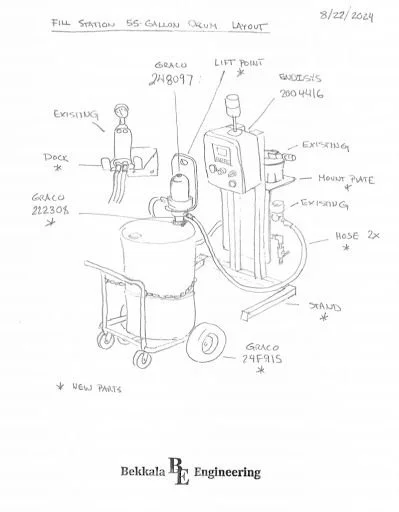
Sometimes that means designing new machinery. Sometimes it means improving existing equipment, simplifying a process, or applying automation where it creates measurable value.
Unlike equipment companies, our goal isn’t to sell you more equipment. It is to fundamentally ensure your manufacturing line operates at peak performance.
BEYOND THE CATALOG
When Standard Solutions Fall Short
Not every manufacturing problem can be solved with catalog equipment or a conventional automation package. And not every equipment builder has the experience, capabilities, or willingness to develop something different.
We approach these challenges by first understanding what your operation needs to accomplish, rather than starting with a predetermined machine or solution.
We examine the entire production process to uncover opportunities to improve equipment, simplify operations, eliminate unnecessary steps, and address the constraints that limit performance.
The right answer might involve advanced automation, custom machinery, a redesigned production cell, an improved control strategy, or an entirely different approach.
We don’t start with the machine you think you need. We start by comprehensively defining the production problem you need to solve.
CAPABILITIES
One Engineering Team. One Production Objective.
Complex production challenges often require expertise beyond a single engineering discipline. Bringing separate vendors together can create gaps in responsibility, miscommunication, delays, and systems that don’t work well together.
We integrate multiple engineering capabilities around one defined production objective, from initial analysis through implementation and support.
01 Manufacturing process analysis
02 Lean-informed system design
03 Custom machinery and tooling
04 Automation and robotics
05 Controls and system dynamics
06 Modeling and simulation
07 Machine learning and adaptive control
08 Testing and validation
09 Installation, startup, and production support
Whether you are developing equipment that doesn’t exist, improving an underperforming process, or seeking expertise your internal team doesn’t have, we bring the necessary disciplines together to engineer a coordinated solution.
A Comprehensive Solution Derives from a Comprehensive Understanding of the Problem
PROBLEM SOLVING
The visible manufacturing issues are often rooted in hidden, system-level problems.
Low throughput may be caused by more than a slow machine. Quality issues may be related to tooling, controls, or process variation. Labor challenges may reveal opportunities to reduce unnecessary handling or simplify production. And unreliable equipment may need a fundamentally different approach rather than another repair.
We use a Lean-informed, whole-system engineering approach to understand how your production operates, identify the true constraints, and evaluate the most effective way to address them. This often results in less equipment build than originally planned.
Simplifying a manufacturing process isn’t always simple engineering. It often requires a deeper understanding of the complete operation. But the result can be equipment and processes that are easier to operate, maintain, and rely on.
12 → 3
manufacturing operations, on a previous project
Our work on previous projects has included
Reducing twelve manufacturing operations to three
Replacing a large, unreliable system with a focused production cell
Improving upstream and downstream production flow
Eliminating unnecessary material handling or work-in-process
Reducing the number of operators required
Increasing output without adding more machines
Improving existing equipment rather than replacing it
Better Manufacturing Performance. Fewer Limitations.
RESULTS
Your production challenges affect more than the equipment on your floor. They impact labor requirements, operating costs, production commitments, product quality, safety, and your ability to respond to growing demand.
We engineer solutions around the manufacturing results that matter to your business.
01 Increase throughput and shorten cycle times
02 Improve equipment reliability and consistent output
03 Reduce bottlenecks and production interruptions
04 Eliminate unnecessary process steps
05 Reduce labor and material handling
06 Lower work-in-process and inventory buildup
07 Use less production floor space
08 Avoid unnecessary equipment and capital expense
09 Improve safety and maintainability
10 Build a production system that supports long-term growth
The objective is not simply a better machine. It’s a better performing manufacturing operation.
Engineered with Your Team—Not Dumped on Them
COLLABORATION
When a manufacturing project involves significant investment, production commitment, and operational risk, choosing the right engineering partner matters.
We work closely with your engineers, operators, maintenance personnel, and production leaders to understand the challenges they experience and the requirements a successful solution must meet.
Their knowledge becomes part of the engineering process, helping us make better decisions, anticipate potential problems, and develop equipment your team understands and can support.
We also recognize that customers may have experienced equipment failures, unsuccessful automation projects, or solutions that have never delivered promised results. Our collaborative approach emphasizes understanding the problem, examining alternatives, and validating the solution before implementation.
You aren’t simply purchasing a machine. You are working with an engineering team interested in solving your manufacturing problem.
Built for the Operation You Have—and the Demands Ahead
Production requirements change. Equipment ages. Customer expectations increase. Labor becomes harder to find. And the machinery that once met your needs may no longer be capable of supporting your operation.
We help manufacturers respond by improving existing equipment, redesigning production processes, developing custom machinery, and integrating automation where it makes sense.
Every solution considers the realities of your operation, including available space, existing machinery, production volumes, operator capabilities, maintenance requirements, upstream and downstream processes, and future growth.
Whether you need to extend the capabilities of an existing machine or develop something entirely new, we engineer solutions around what your operation needs to accomplish.
Integrated Engineering. From Challenge to Production.
HOW WE WORK
Manufacturing projects involve technical, operational, and financial risks. Our coordinated engineering approach helps define the problem, evaluate possible solutions, and carry the project through implementation.
01
Understand the system
We study the process, equipment, parts, operators, workflow, constraints, and production goals.
02
Identify the real constraint
We separate the visible symptom from the underlying manufacturing problem.
03
Develop and compare solutions
We explore multiple approaches, including process changes, machinery, automation, controls, tooling, and operator involvement.
04
Model and validate performance
When appropriate, we use engineering analysis, modeling, simulation, testing, and first-principles controls to verify the approach. Our technical capabilities are more akin to a product engineering consultancy, exceeding those normally housed with standard equipment builders.
05
Engineer and implement the system
We coordinate design, fabrication, programming, integration, testing, installation, and startup.
06
Support production
Our involvement does not end when the machine is delivered. Customers can continue to call on us as production requirements, equipment, and challenges evolve.
ALSO We also provide continuous improvement systems for equipment, with machine learning and adaptive monitoring.
Bring Us the Problem Others Haven’t Solved
The machine doesn’t exist. The equipment no longer performs. The bottleneck is limiting your growth. The production challenge that previous solutions couldn’t resolve. These are the challenges we love to unpack, document, and solve.
Show us where your production is challenged. We’ll work with you to define the underlying problems, explore your options, and determine the right engineering approach.